
NTS Story 1: What Non-Technical Skills (NTS) are most important to safe train driving?
Non-Technical Skills (NTS) can be described as those personal characteristics that you and I bring to our work roles that help us to be safe, effective and efficient. These NTS can include our abilities, personality, interpersonal skills and our motivations.
Key research identifies 26 Non-Technical Skills for train drivers
In 2012 the Railway Safety and Standards Board (RSSB) published some key work research that identified 26 NTS for train drivers. These NTS were categorised under seven headings, including but not limited, to situational awareness, communication and workload management. Many UK train and freight operators have now incorporated NTS into their driver operations and are actively using NTS to improve driver effectiveness.
OPC psychologists work to identify what Non-Technical Skills are most important to train driving?
Having 26 NTS that we expect our train drivers to possess and live out in their day-to-day driving is a positive development for our industry. However, a key question often posed by our rail clients is: What NTS are the most important to train driving and which should we focus on with our drivers?
To answer this question OPC psychologist asked 81 train driver experts (driver managers, trainers and instructors) from 4 leading UK train operators (commuter and long distance) to rate the importance of the 26 NTS to train driving. We analysed the data and ranked the NTS in order of importance to safe train driving. The results are displayed below:
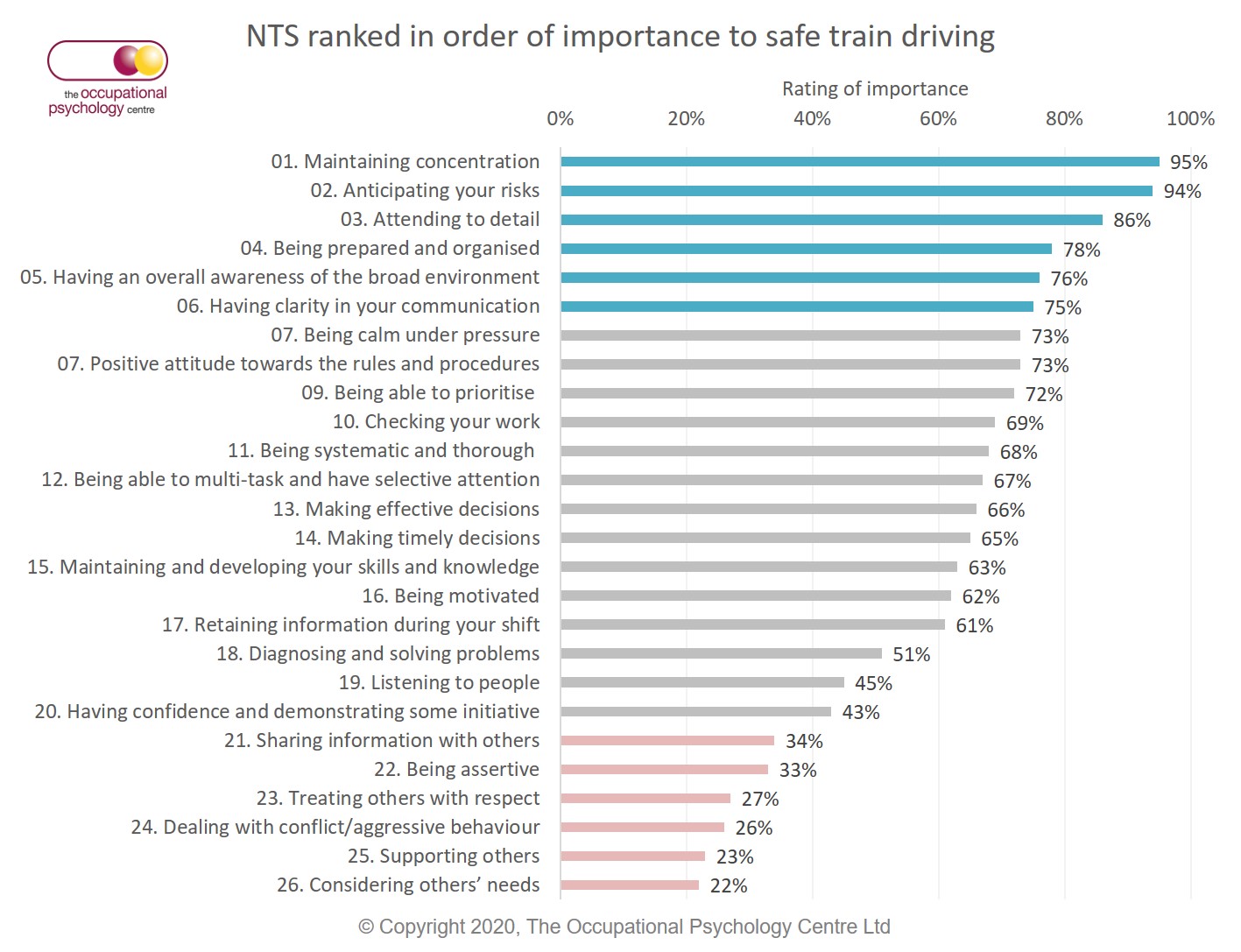
The findings indicated that the most crucial NTS’s were some very important ones, such as maintaining concentration, anticipating risk and having an overall awareness of situations and surroundings – these are key Non-Technical Skills to keep a driver, the onboard team and passengers all safe.
Putting the top Non-Technical Skills to effective use
Many OPC rail clients have selected and focused on their own most important NTS to deliver in depth NTS training for their drivers and driver managers, depending on the type of driving, traction and/or the business priorities. One rail client trained all their train drivers in their top 3 NTS including maintaining concentration, attention to detail and the anticipation of risk. Another rail client trained over 1,000 train drivers in their top 6 NTS, with positive feedback from the managers and drivers alike.
Want to know more?
If you would like to know more about how Non-Technical Skills (NTS) can help your drivers and other safety critical staff improve safety performance, please contact us.
This article was published on Rail Business Daily (RBD) on 9th November 2020.